
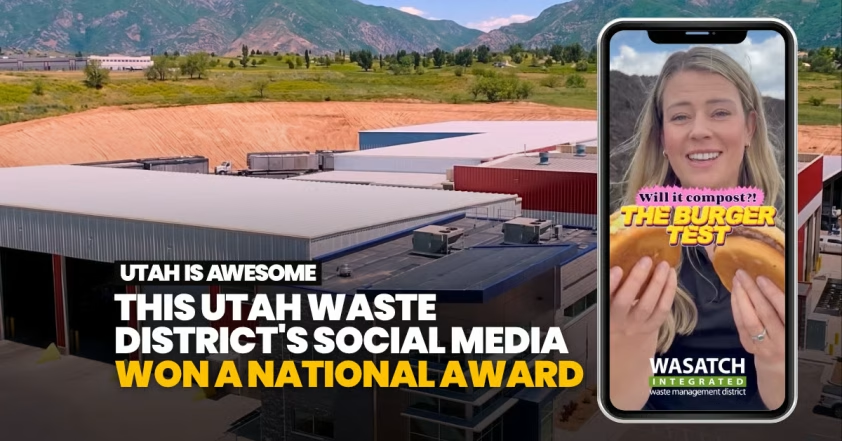
Wasatch Integrated’s “Is This Compostable?” series wins national award for outstanding social media campaign

TL;DR A Grow the Flow billboard showing Great Salt Lake's water level is back on I-15 and I-215, now reading 29.7% full. The lake has dropped from 37.5% full since the nonprofit first ran the billboard in early 2025. More than 57% of the lakebed, or 1,227.5 square miles, is exposed, according to the group. Drivers on Interstates 15 and 215 can once again check Great Salt Lake's condition from the road, as the nonprofit Grow the Flow brings back its lake-level billboard with the lake now at 29.7% full. What we know: Grow the Flow, a nonprofit working to restore Great Salt Lake, first put up the tracker billboard in early 2025. It read 37.5% full at the time, according to the group's Oct. 6 announcement. The billboard updates as lake conditions change. It rotates among billboard locations along I-15 and I-215, stretching from Lehi to North Salt Lake. The percentage compares the lake's current volume with its natural volume at an elevation of 4,207 feet, Grow the Flow says. White Rock Bay Exposed Lakebed Photo credit: Grow the Flow By the numbers: Here's where the lake stands and what restoring it could take, according to Grow the Flow: 29.7%: How full the lake is, down from 37.5% in early 2025 1,227.5 square miles: Exposed lakebed, more than 57% of the total 26%: Share of the lake's natural area within the healthy salinity range for its ecosystem 2.5 million: Utahns living downwind of toxic dust from the drying lakebed 1 million acre-feet: Additional water needed each year for a 70% chance of reaching a healthy level by 2054, according to the Great Salt Lake Strike Team $2 billion to $10 billion: Economists' estimated cost to restore the lake What they're saying: "Now is the time to harness the years of legislative preparation and intense public concern about the lake," said Ben Abbott, executive director of Grow the Flow and an ecologist at Brigham Young University. "The next several months will be critical in determining its future." Samantha Hawkins, the group's communications director, says the billboard is meant to keep the issue in front of the public. "This lake tracker puts the reality of Great Salt Lake's decline in front of thousands of Utahns every day," Hawkins said. "That kind of visibility helps build the public support needed to advance practical solutions and make Great Salt Lake a priority for our state leaders." Why you should care: If you live along the Wasatch Front, the shrinking lake can affect the air you breathe. Grow the Flow says dust blowing off the exposed lakebed puts 2.5 million Utahns at risk. The group also points to losses in wildlife habitat and less lake-effect snow for Utah ski resorts. Continued decline could hurt property values and public health and cost the state billions of dollars, according to the release. What's next: Gov. Spencer Cox set a goal in September 2025 to bring the lake back to a healthy range by the 2034 Olympic Games. Since then, the state dedicates new water to the lake and creates new tools to secure more flows, but Grow the Flow says those efforts fall well short of what the lake needs. The Great Salt Lake Strike Team's 1 million acre-foot estimate targets a healthy lake by 2054, 20 years after the governor's deadline. Abbott says the coming months matter because a single good snow year won't reverse the long-term decline. More information on the tracker is available at GrowTheFlowUtah.org.

Wasatch Integrated Waste Management District has received the Solid Waste Association of North America’s (SWANA) 2026 Outstanding Social Media Campaign Award for its “Is This Compostable?” video series. The series was produced in partnership with Saltworks Digital, a Salt Lake City marketing agency.

The award comes from SWANA’s Communication, Education & Marketing Technical Division. SWANA announced winners in August and presented the award Sept. 30 at its Awards Celebration during RCon 2026 in St. Louis. Wasatch Integrated was the only Utah organization among this year’s SWANA award recipients.

In the series, district staff place unusual items in the pile at Wasatch Integrated’s compost facility and document how quickly they break down. One episode, “Battle of the Burgers: Compost Edition,” pits fast-food burgers against each other. The format turns a common resident question — what actually belongs in the compost? — into content people want to watch and share.

“Most residents only think about us on collection day, and that’s exactly why social media matters so much,” said Preston Lee, executive director of Wasatch Integrated. “It lets us show up between those moments, answer the questions people really have, and have some fun doing it. Every video is built around what we hear from the communities we serve across Davis and Morgan counties.”

Lee credited the district’s agency partnership for the campaign’s tone. “Saltworks has been a true creative partner,” he said. “From day one, they understood we didn’t want polished corporate messaging. We wanted something our residents would recognize as their own, and this award shows that approach works.”

The campaign was led by Nina Groom, social media manager at Saltworks Digital.

“Wasatch Integrated is the kind of client every creative team hopes for — they’re willing to put a cheeseburger in a compost pile and see what happens,” Groom said. “The team brings real expertise and a great sense of humor, and they trust us to let both show. That matters, because audiences today can spot a scripted ad instantly. What earns attention now is authenticity: real staff, real facilities and honest answers to real questions.”

Lee also represented the district on the RCon 2026 main stage, joining a panel discussion titled “Innovation: Nature-Based Solutions and the New Economics of Circularity.”

Add a comment

Leave a Reply

Your email address will not be published. Required fields are marked *

Previous Post
Next Post
Advertisement